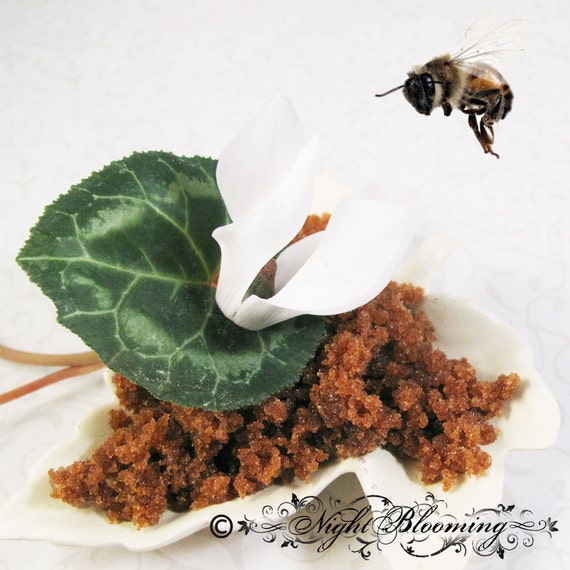
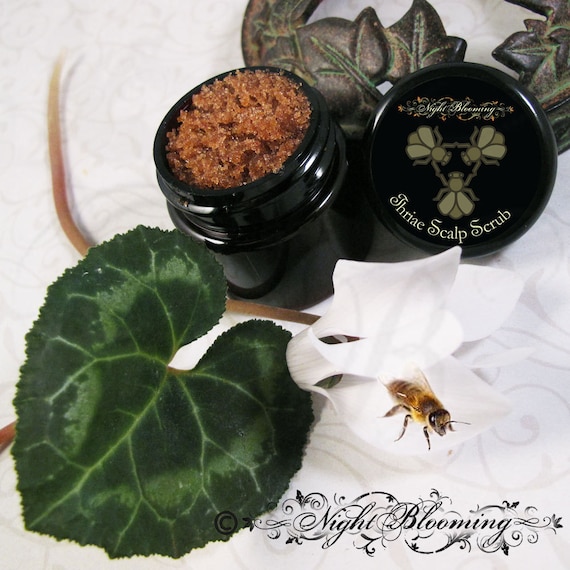
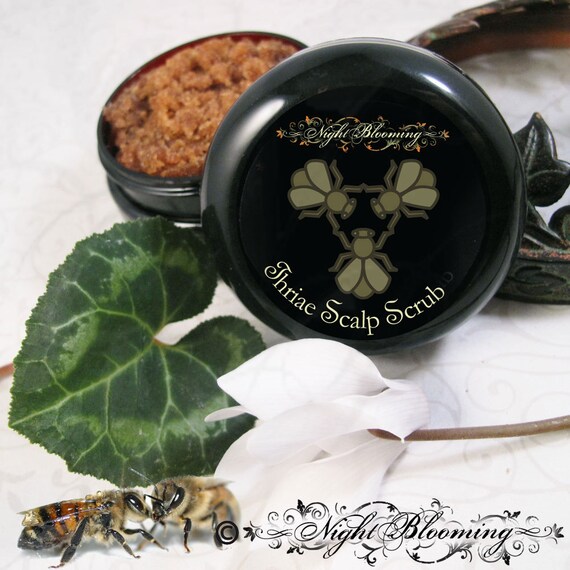
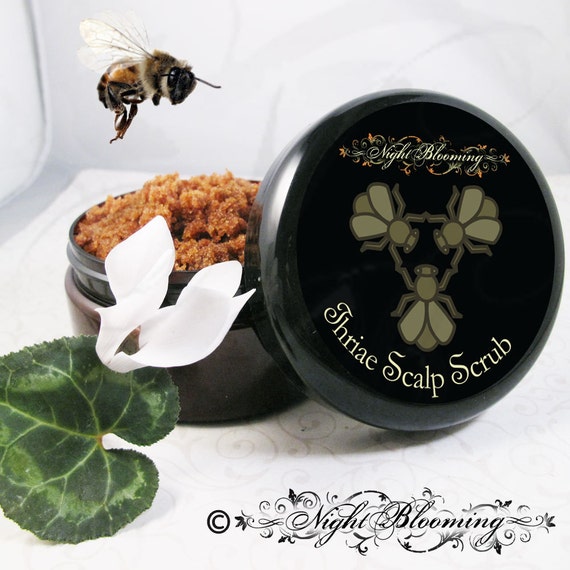
We're happy to bring you another new product, Thriae Scalp Scrub! Beat flaky scalps, winter itchies, and scalp buildup with this gentle, effective, and healing scrub. While formulated with the scalp in mind, Thriae works great for the skin on the face and the rest of the body, too!
Who were the Thriae?
The Thriae were a trinity of pre-Hellenic Aegean bee goddesses, sometimes called bee maidens or bee nymphs. Like many trinities, each of the three had their own special gifts, and in the same turn, Thriae Scalp Scrub has three key benefits:
 |
The Thriae logo is a variation of the
Merovingian Bee, symbolizing diligence
and resurrection. |
- Exfoliation: Thriae uses organic brown sugar as a gentle way to scrub away buildup and flakes from the scalp. It is more gentle, and more effective, than salt.
- Moisture: Honey is a natural humecent, meaning that it helps draw moisture inward. The natural oils help restore the natural scalp oils lost by cleansing and also helps keep the moisture gained by the honey in the scalp.
- Healthy Scalp Promotion: Honey is has natural antibiotic and antifungal properties and this is coupled with the many benefits of the essential oils. While detailed fully below, they include promoting hair growth, promoting scalp circulation, reducing itching, PH balancing, and scalp soothing.
Ingredients:
Certified Organic Dark Brown Sugar, locally sourced raw honey, cold–pressed unrefined sunflower oil, evening primrose oil, shea nut oil, nettle-infused oil, sea buckthorn oil, and the essential oils of bay, birch, cedarwood, german chamomile, lavender, red thyme, rosemary, sage, tea tree, and ylang-ylang.
Free of: parabens, silicones, synthetic fragrances, and artificial coloring agents.
Directions:
Apply to damp or towel-dry hair. Sopping wet hair will dissolve the scrub faster than you want, and if your scalp is too dry then the abrasion will be too harsh. Try Thriae while soaking in a relaxing hot bath.
Scoop out a bit of scrub and work it down to the scalp with your fingers. Don't worry if it gets on your hair, it won't hurt it at all! Work the scrub into the scalp using a small, gentle circular motion, adding more scrub as needed. When the scrub has dissolved, let it sit for a few minutes on your scalp so the beneficial properties of the honey and Triple Moon Oil can work their magic. Got leftovers on your hands? Work it into your face too, just be careful not to get it in your eyes, nose or mouth. It won't kill you, but it isn't a good idea to ingest anything with essential oils. Yes, it smells sweet and yummy- don't eat it!
Water alone may not be enough to get the residue from the scrub out, so you can use your favorite method of washing to remove it. As you rinse, be sure to work your fingers at the scalp, ensuring that water can rinse things clean. You may notice you shed a few more hairs than normal, this is expected and nothing to worry about! The hairs that were ready to fall out in the next day or two just got worked out a bit sooner with the scalp massage, you're not losing any hair you weren't going to anyway! And that's it! Enjoy this whenever your scalp could use a little extra attention!
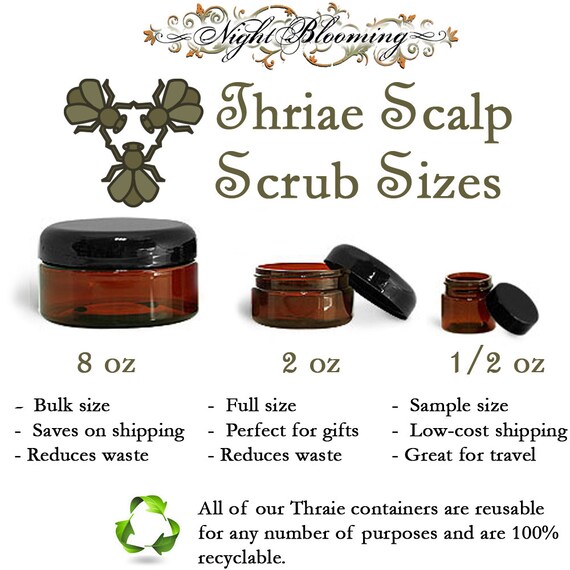
Sizes:
Just like our Panacea hair salve, Thriae comes in three sizes!
Storage:
Store-bought beauty products contain synthetic ingredients to hold mixtures together. Thriae , not having these synthetic ingredients, may separate. If it has separated, simply stir until fully blended. If Thriae has become hard, scoop out with a butter knife and gently crumble it in your hands before using. Thriae Scalp Scrub has a shelf life of two years unrefrigerated, longer if kept cool.
Detailed Ingredients Descriptions:
Certified Organic Dark Brown Sugar – Salt scrubs are sometimes dangerous to your skin as the size of the grain can cause microscopic tears. Since brown sugar has smaller particles, it is gentler and safer exfoliant.
Locally Sourced Raw Honey– Contains natural vitamins, enzymes, powerful antioxidants and other important natural nutrients. These are the very nutrients that are destroyed during the heating and pasteurization process. Our honey is only sourced from local, ethical beekeepers who put the health of the bees before all else, and use organic colony health management. Honey is a humecent, so it draws moisture into the skin, while acting as a natural antibacterial and antifungal treatment.
Organic Cold–Pressed Unrefined Sunflower Oil– An oil wealthy in Oleic acids with high amounts of Vitamins A, D, and E, also has beneficial amounts of lecithin, and unsaturated fatty acids. Deeply nourishing and conditioning for the skin and hair it is a natural emollient (meaning it corrects scaling and dryness), by helping upraised skin and hair cells lay flat, helping to increase shine and keep in moisture. Cold-pressed oil, also called cold-drawn, or virgin, oil, is purer than oil expressed with the aid of heat and retains more of its natural benefits.
Evening Primrose Oil– Evening Primrose Seed Oil is pressed the seeds of the Evening Primrose plant, Oenothera biennis . The yellow flowers only open in the evening, hence their common name. Evening Primrose Seed Oil is a rich source of gamma linoleic acid, an Omega 6 fatty acid and nourishes the scalp, hair, and even your nails.
Shea Nut Oil– A beautiful oil with a deep golden color which is made by cold-pressing the nut seed of the Shea (Karite) Tree. Shea oil is a byproduct of Shea butter production where the pressing of the seeds produces a fractionated oil. This oil leaves a smooth and healthy feel to the skin and hair buy helping rough and upraised cells smooth back into place. It offers benefits for numerous skin problems including dermatitis, eczema, burns, cutaneous dryness and other irritations. Highly recommended as a protective agent against harsh weather conditions where a mild barrier against the elements is desired.
Nettle-Infused Oil– Fixed or essential oils are not obtained from this plant but extracts are produced, although not by distillation. The plant, organically grown, is macerated in virgin olive oil to produce nettle oil which contains the lipid soluble constituents. Used for treating eczema and other conditions causing itching of the skin and is natural deep cleanser useful for oily skin and hair. Nettle is also said to promote hair growth.
Sea Buckthorn Oil– So rich in vitamins and nutrients that it has been even speculated that the plant must have been cultivated by some ancient plant-breeder. A useful, highly prized, and specific oil typically used to treat damaged skin, ulcerations, scar tissue, wrinkles, eczema, burns, etc. Cold extracted from whole Sea Buckthorn berries, it is a moisturizing and anti-inflammatory, scalp soother. This oil is exceptionally rich in essential fatty acids, carotenes, tocopherols, and phytosterols.
Bay Essential Oil– Bay is a scalp stimulant and antiseptic astringent and was very popular with the Romans, who thought Bay was a symbol of wisdom, peace and protection. The Latin Laudis means “to praise,” which is why the victors at the Olympic games were presented with a Laurel (Bay) Wreath. The priestesses at Delphi sat over the burning fumes to increase their prophetic visions.
Birch Essential Oil– Birch oil is another herb that is believed to help promote hair growth. This herb is often recommended to people who may be experiencing hair thinning, as it is also known to slow down hair loss.
Cedarwood Essential Oil– Excellent for both hair and skin care. It balances oily skin, soothes and helps to heal skin rashes, reduces oil in hair and skin. Famed cedars of Biblical times (Lebanon cedar) provided one of the world’s earliest perfumes. Other ancient cultures used cedarwood for sarcophagi and palace and temple building material.
German Chamomile Essential Oil– Promotes hair growth, scalp soother and hair conditioner. This most soothing of herbs was used in ancient Egyptian medicine as an emblem of the omnipotence of Ra through its power to restore wholeness to the Self.
Lavender Essential Oil– Enhances hair growth by stimulating the scalp. The name “lavender” is derived from the Latin lavare, meaning, “to wash” and was known as one of the seven polyvalents (effective against many toxins). Greeks and Romans perfumed their bathwater with lavender, burned lavender incense to appease their wrathful gods, and believed the scent of lavender to be soothing to untamed lions and tigers.
Red Thyme Essential Oil– Helps control an oily scalp and stimulates the scalp, promoting hair growth. So important was the herb’s aroma that its name was culled from the Greek thymon, meaning, “to fumigate.” Indeed Roman soldiers bathed in thyme before entering a battle, and in the Middle Ages sprigs of thyme were woven into the scarves of knights departing for the Crusades. Most present-day research has centered on thyme’s ability as an antibacterial and anti-infectious agent, even when diffused in the air.
Rosemary Essential Oil– An antimicrobial/antiseptic scalp stimulant and soother; to the ancient Greeks and Romans the plant was sacred, symbolic of loyalty, death, and remembrance, as well as scholarly learning. At weddings and important occasions, wherever solemn vows were made, garlands and headdresses of rosemary were worn, as an emblem of trust and constancy.
Sage Essential Oil– A scalp soother and astringent, the herb is of ancient repute, valued as a culinary and medicinal plant – called herba sacra, ‘sacred herb’, by the Romans
Tea Tree Essential Oil– A long-reputed herb for its ability to sooth irritated skin, this oil reduces the itching of an irritated scalp. The aboriginal peoples of Australia soaked the pungent leaves in hot water and used them in all manner of medicinal treatment.
Ylang–Ylang Essential Oil– The extract of lilies, this oil is a scalp soother and follicle stimulator. Indonesians spread the luxuriant flowers on the marriage bed of the newly weeded couples. Ylang means “flowers of flowers,” sometimes called “the perfume tree.”