Showing posts with label Honey Bees. Show all posts

Monday, April 18, 2016

Find the queen, win a 2oz Thriae!

This past weekend my husband and I split our surviving hive so we would again have two hives! That means we opened up one hive:


Inspected each comb to determine what was on each, and then divided them between the two hives.  The hive that doesn't have the queen will raise a new one, and the one that does doesn't need the youngest brood comb, which is what the queenless hive will raise a new queen from. Finding a queen bee is HARD.  Most times you will never, ever see her, but my eagle-eyed husband spotted her. This was awesome as it let us divide up the comb in an ideal way to best support the queenless hive.

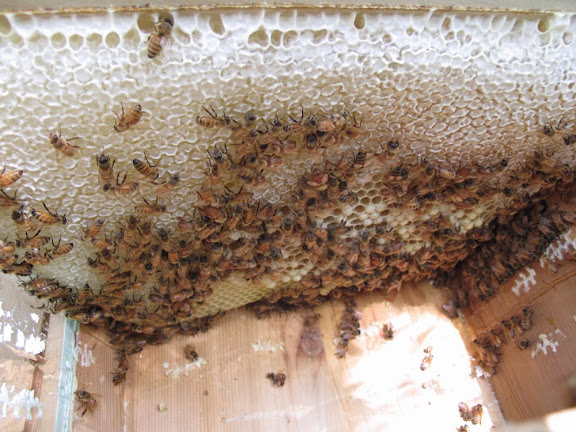
So here's the deal: The queen bee is in this picture.


 If you find her, mark her (with Photoshop, MS paint, whatever),and send me the picture either by email or by Etsy convo through Wed, April 20th.  

I'll draw winners from the entries and will include a free 2 oz Thriae Scalp Scrub with your next order! 


Why April 20th? It's our 9-year anniversary and we'll have even more fun things then! Good luck!

Wednesday, January 13, 2016

25% off Thriae and Winter Bee Pictures


I was out taking pictures of our wonderful bees the other day and realized there's nothing better for a dry, itchy winter scalp than Thriae Scalp Scrub!  In honor of our little bees being bundled up for the winter, we're offering 25% off on Thriae until Jan 20th, or while supplies last.  This applies to all three sizes, the 1/2 ounce sample, the 2 ounce full size, and the 8 ounce big size.

Keep in mind that in winter the scrub tends to contract a bit during shipping, so you'll need to warm it up once it arrives and give it a little fluff with a spoon!


Winter Bees


As you might recall, we keep Minnesota Hygienic honey bees in top bar hives. They're amazing little creatures and a total joy to have around.  We only harvest their honey in the spring because, well, honey is what nature designed bees to eat over the winter!  The thick honey combs are also key to insulating the hive in the winter as they gather warmth at the height of the day and then slowly release it overnight to help keep the bees warm.  Come spring, when the flowers open and the nectar flow begins, the bees will ignore the stored honey in favor of fresh nectar.  Only then will we take whatever they don't use over the winter and are no longer interested in eating.

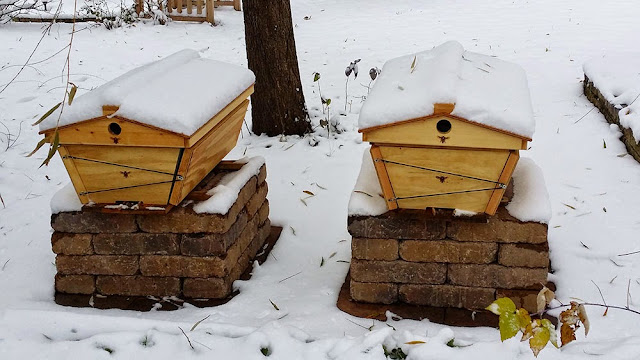
We also have insulation panels on the hives and that nice thick layer of snow on the top of the hives will add additional insulation.

A quick peek through the windows on the side shows that both the pine hive and cedar hive bees are doing great!


In the winter, honey bees clump up into a ball and rotate bees in and out of it to keep warm. (Honey bees are also the only insects that actually produce warmth.)  It's actually much the same way that penguins survive the bitter cold, by sharing time on the outer circle in the cold, then moving inward to warm up while others take their turn sheltering the inner core from the cold.

The temperatures dropped here, but tomorrow is supposed to be above freezing at the height of the day, so hopefully the bees enjoy their break!

Thursday, November 20, 2014

Winter Bees

Winter Bees

It's been a busy fall (it always is).  There's herbs to collect, a billion leaves to rank and turn into leaf mulch, a garden to pull out, and now, bees to prepare for winter.  The bees are all settled in.  We've given the apiaries insulating roofs and insulation panels to help keep them warm. Inside, the bees will form a tight cluster around the queen, shivering their wing muscles to keep one another warm.  Think of how penguins in the Antarctic form one large group, taking turns on the outside and then moving back into the group to warm up.  Bees do something similar, and this cluster moves slowly through the hive in the winter, the bees on the outside of the cluster picking up honey and feeding it inwards.

They'll be dormant probably until sometime in April, and I worry.  I know people in Alaska keep bees, but still, the winters are very cold and long.  Hopefully they'll be okay!

We also acquired a new honey jar for the house.  It's small, which is awesome as I try to use it sparingly, but also fits perfectly in the pantry.


The reviews on it often complain about it being messy, but I haven't had an issue with it.  I just let the honey drizzle back into the jar until it stops for a second, then move the wand over the lip of the jar. 

Ficcare Update

I've got updates on the Primavara Project coming, so sit tight :)  It's just been super-busy, but I'm plugging away!


Thursday, August 7, 2014

First Honey Harvest

This past weekend we had another adventure into the hives. They were getting towards the back, so we had to go in and see what was going on and possibly remove a few comb.

The good news is that with our past adjustments the pine hive never did swarm and seems to have settled in to make honey. So DH and I suited up and headed up to the apiaries. 

We started with the pine hive and worked from the back forward. We have a tub that we set the top bars in as we're working. Turns out that the pine hive was already building on the last top bar. This is the comb they were working on, filled with dehydrating nectar:


Here's another few comb, the foremost one is honeycomb at the top (that's capped honey), then empty comb at the bottom and a small patch of brood comb at the lower left:


And a whole bunch of top bars:

 
We decided on two comb to remove from the cedar hive, one that was build all wonky and a second that was mostly empty brood comb. That was we could encourage a smaller brood nest and give them more room to build up their honeycomb stores for winter. Then we went into the cedar hive. This hive had no wonky comb, except the front one, which we left. I have no idea what the hell they're doing, but I was feeling like it was going to be a mess just trying to get that one out XD The biggest concern with wonky comb is that they'll keep that same pattern for the rest of them, but since the comb following was fine we weren't worried.
 
Here are the comb we decided to remove.  They had honey comb at the top, which we'd already broken off:
 
After everything was put away we were able to appreciate our spoils:


And then it was into the house for processing! Here's our honeycomb. The weight on the scale is including the bowl. Once I melted down the wax, weighed that, and then weighed the bowl I figured out we got about 4.5 pounds of honey. That's way more than I expected from just taking out three junk comb!
 
 
We really didn't have enough to justify using our big straining buckets, but I wanted to try anyway. There's two buckets, and the top filters into the bottom one with the valve. 
 
 
I started by loading the comb into the top bucket, which has a punched metal floor and then a mesh bag for filtering:
 
 
And then squished it up with the potato masher:
 
And this is all we had. it didn't even come up to the bottom of the valve:


But in practice it turned out to be quite a lot! I kept some capped honecomb (because I love eating it), but here's the rest all bottled up. We had a side of cranberry and quinoa with dinner and drizzled honey on the top. It was *amazing*.


A small jar and some circular comb going off to my best friend:


All the same honey, just different thicnkesses/amounts so the smaller jar appears more golden and the most full jar the darkest.

Safe to say, this is SUCH a fun hobby. It's much more fun and much cooler than I ever expected, stings and all.


Monday, July 14, 2014

Rendering Beeswax

This past weekend I tried my hand at refining the bit of beeswax I had.  That's one other advantage of the top bar hives, I think, is that you remove the wax and can use the entire comb rather than just the cappings.  That way the comb gets cycled out rather than being used over and over and over.  Reusing comb means faster/more honey production as the bees don't have to make the wax and the comb, but it also means that anything wonky with the hive can build up in the comb and with the top bar hive you remove them so the bees have fresh, clean comb more often.

After cutting out some cross comb I had about a gallon baggie full of it:
This comb is very white and pretty clean because we took it out before they could build anything in it.  Cross comb means it was going across two top bars and would be impossible to remove if we didn't correct them.


A little quick reading to see what I was supposed to do, and I had a double boiler set up with an old pot and bowl:


In went the comb:


And in not too long I could see it starting to melt:


I don't have pictures of the filtering process as I needed both hands for that, but essentially I did this, making a filter out of cheesecloth into an old almond milk carton:


And then from there I poured the filtered wax into my spiffy little molds:


And ta-da!  I can't believe how FLORAL it smells. I've never smelled beeswax like it.


Monday, July 7, 2014

First Honey & Enyo Release

Update on Our Bees


The honey bees have settle in nicely and are going crazy producing both comb and honey.  It's facinating to watch them on the flowers in the yard and also drinking off the lillypads in our pond.

A honey bee on a flower in our garden
 
Bee on a stick!  They're very gentle.
 
Inside one of the hives.  That's honeycomb on top and drone comb near the bottom.
 
A bee in flight under our cherry trees, carrying pollen back to the apiary.
 
Our first bit of honey!


We checked on the bees and found they were building cross comb in one place (meaning not straight across on the top bars, making it something we wanted to discourage), so we had to cut the comb out.  There was a bit of honey in it and it's amazing.  Floral and sweet and probably the best honey I've ever had.  We won't be harvesting honey in bulk until spring, but it was nice to try a bit without taking away from the bees' main stores.


Releasing Enyo War Goddess Henna Hair Color


A long time coming, I was finally able to find time to make a good big batch of this to post!  You can check out the 10g samples and the 100g full sizes. 


In closing, the very talented Sinead Anja Hering laid claim to her poem Freya in our previous post!


Sunday, April 27, 2014

The Honey Bees Have Landed!


Our honey bees are here!  They're so immensely cute, and we're glad we took the time to set everything up for them and settle them in properly.


We have two apiaries, one made of cedar (the one with the darker stripe) and the other is pine.  The apiaries are top bar Golden Mean hives, built with plans from here.  They are under a deciduous tree (weeping willow), which means it will get sun to warm them in the winter, and shade in the summer.  They're facing where the sun rises, and also pointed towards the privacy fence:


Pointing them at the fence helps cut down on the wind that the front of the hives faces, and also forces them to fly up after they leave the hive.  This means we won't have a stream of bee traffic straight out across the yard.  At this point all we needed was bees.


The day we went to get them was very cool and drizzly.  We drove way, way out into some beautiful bluff country and to the bee farm.  So I had two of these in the backseat with me:


By the time we got home it was starting to get a little dark.  We moved the false back on the hives to the center, took out a few top bars, and pulled the feeder can from the first package (that's the silver can in the above picture, you can kind of see it on the top of the package).  Bees started coming out, but just crawling because it was cool.  Bees don't like to fly unless it's over 50 degrees F. 

We removed the queen cage (which you can't see, all the bees are massed around her), and then I turned the first package upside down and started shaking the bees into the first apiary:


At some point when I was forcibly shaking 20,000 cold, unhappy bees vigorously I thought, "What the f*ck am I doing?"

I had been worried about the chill, but it proved to be a good thing, they didn't fly around and mostly stayed put.  We then peeled back the screen on the queen cage, released her into that mass of bees, and closed up the apiary.  Then repeated for the second one.

 We put in a feeding tray in each one, with an old bamboo mat for traction and some slightly diluted honey:

When we were finished, they looked like this:

Those are the packages the bees came in on the bottom and the feeding cans we removed to the left of each apiary.  

The next day we wend and checked on them through the window.  The bees had done as we hoped and balled up at the top front of each hive:

It was still really chilly, though, so they weren't doing a whole lot. 

The day after, however, it was nice and sunny and they were out and about:


So cute!  And so docile!  We had no stings at all putting them in or for the next few days.  Got one on Friday when we fed them because I dropped a stick into the hive and went to get it back.  I guess it was THEIR stick, dammit.  But generally, they're very tame.


We love them.  They're so much fun to watch.  Inside that ball of bees they should be constructing comb, so we'll see how fast they go once the weather warms up and the flowers bloom.